
Complicated vs Simple
How to make your message clearer (and drive action)
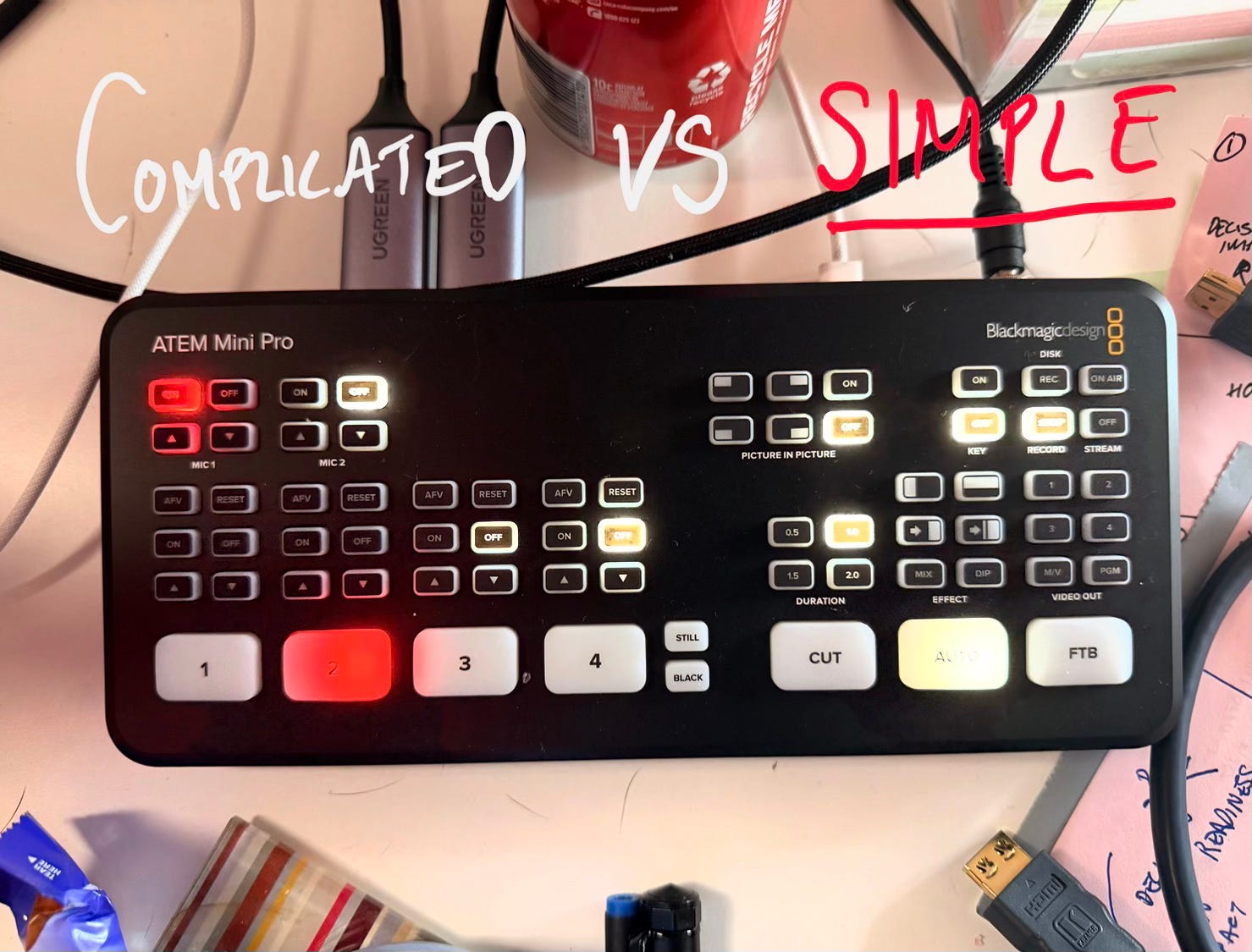
Image: Matthew Needham
A few weeks ago, I invested $449 in an ATEM Mini Pro to help make my Commercial Conversations workshops more ‘professional’.
But instead of making them better, I actually made them worse.
The ATEM Mini Pro lets you switch between cameras, microphones or screens when broadcasting and is an excellent piece of kit.
It’s a piece of kit that lots of' ‘pros’ use - including streamers and webinar hosts I like.
I thought it would be great to seamlessly switch between my presentation on my MacBook and my iPad.
I thought it would be simple.
It wasn’t
Despite me spending hours (and I do mean hours) trying to get it to work, including watching countless YouTube videos and asking ChatGPT for help - it wasn’t simple at all.
So after spending way too long trying to get it to work, I decided to cut my losses and give up.
Effective vs Impressive
One of the hardest things to do during a webinar is juggling multiple tasks. Managing the technology, running breakout rooms, answering questions and making sure everyone is on the same page takes a heavy cognitive load.
So anything that makes running a webinar more effective has got to be welcomed.
When I was reflecting back, I realised I hadn’t bought the kit to be more effective; I bought it to be more impressive.
I bought the kit because I’d seen a webinar where the host didn’t do a brilliant job because he was using the Mini Pro to deliver his session.
His session wasn’t good because he had a Mini Pro - it was good because of the content.
Then I realised
This is exactly what happens in Finance teams producing the month-end pack.
More slides.
More detail.
More polish.
Less clarity.
All trying to look smart, demonstrate the new Power BI report the team spent all last week building, and sound more credible.
But actually, by including more, it takes the stakeholder longer to read and understand it, and instead of making things easier, we’ve made it harder to understand.
Why this happens
I’m yet to meet a Finance leader who hasn’t wanted to do a good job. They want to be helpful and support better decisions. However, they know that the message doesn’t always land with the stakeholders.
So instead of removing stuff from the report. Finance leaders add stuff. Trying to be helpful. Trying to show that ‘hey, we’re Finance’ and we’ve got this.
Finance leaders make the mistake of confusing adding detail with adding value.
The consequences
When things aren’t clear:
People nod, and
Nothing happens.
And that’s why Finance teams fail to influence.
Three things you can do to improve your monthly reports
The goal should not be to include more. In fact, the goal should be to include less.
But by including less. It’s to make it obvious what decision is required and what the next steps should be - that’s not some vague statement about the need to cut back on overtime.
So, what should the report include:
Start with the point - can you explain it in one sentence?
Make the decision obvious - if there’s no decision, does your point need to be made?
Explain the impact, as well as what happens if we do nothing.
Remember:
I spent $449 trying to look more professional, but instead it made me less effective.
Clarity beats cleverness. Every time.
P.S. Whenever you’re ready, for more information on how I can help your Finance Team or Senior Leaders have better conversations about financial performance go here